 HomeCountiesArticlesMethodologyContact
How Towns Built Around One Employer or Industry Collapse After Mass Job Loss — and What the Historical Record Shows
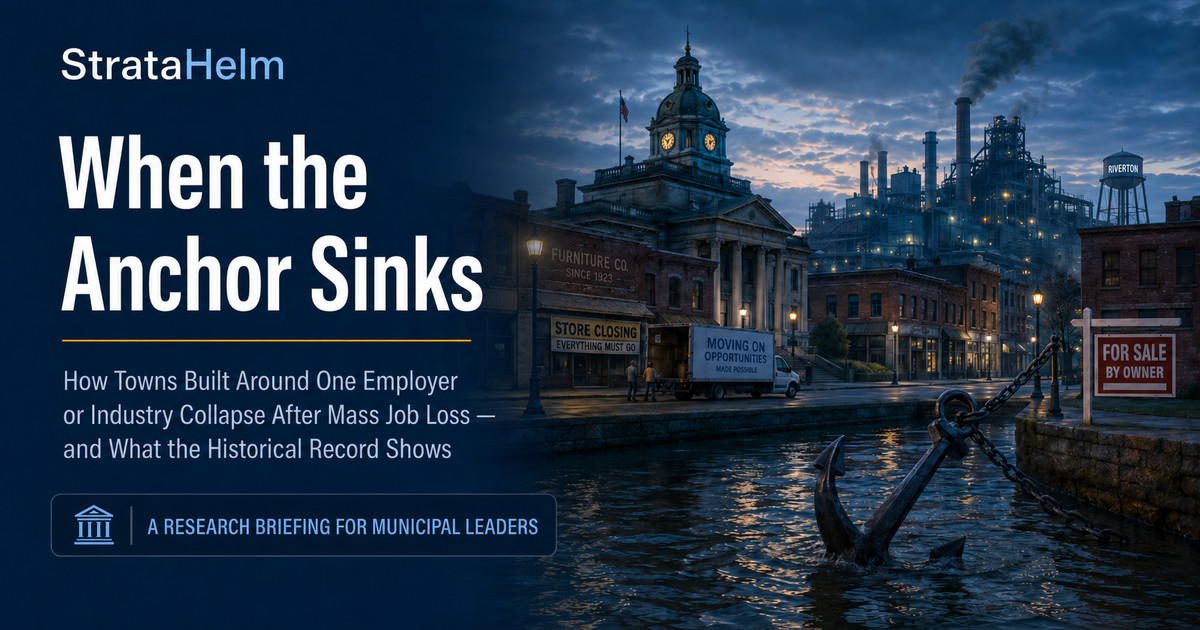
Communities that concentrate their employment in a single company or industry enjoy outsized prosperity on the way up and suffer outsized devastation on the way down. This briefing examines the best-documented American cases — Youngstown, Ohio (steel); Flint, Michigan (autos); Gary, Indiana (steel); and Rochester, New York (film and imaging) — to identify the repeatable pattern of collapse. The pattern matters today because economists studying artificial intelligence warn that regions concentrated in white-collar back-office work may be the "mill towns" of the next disruption. The mechanics of collapse are remarkably consistent: a direct job shock, a multiplier effect that takes down two or more supporting jobs for every anchor job lost, a fiscal spiral as the tax base erodes, and a demographic exodus that can cut a city’s population in half. The single most important finding for municipal leaders: the towns that fared worst were not the ones hit hardest, but the ones that were least diversified and slowest to accept that the anchor was not coming back.
There is an old joke in economic development circles: the best thing that can happen to a town is landing a major employer, and the worst thing that can happen to a town is landing a major employer. Concentration is a bargain with terms written in invisible ink. While the anchor thrives, wages run above the national average, homeownership soars, and city hall enjoys a reliable stream of income and property tax revenue. Youngstown at its steel-era peak had above-average wages and one of the highest homeownership rates in the country (Belt Magazine, 2017). But concentration means the town’s fate is decided in a boardroom it does not control — and often, as Youngstown learned when its flagship steelmaker merged with a New Orleans conglomerate, a boardroom that is not even in the same state (Wikipedia, "Economy of Youngstown, Ohio").
On September 19, 1977 — remembered locally as "Black Monday" — the Youngstown Sheet and Tube Company abruptly announced the closure of its Campbell Works, laying off roughly 5,000 workers overnight (Belt Magazine, 2017). It was the first domino. U.S. Steel exited the area in 1979–1980, and Republic Steel went bankrupt in the mid-1980s. Within five years of Black Monday, approximately 50,000 jobs had disappeared from the Mahoning Valley (Belt Magazine, 2017).
The secondary damage is what municipal leaders should study most closely. An estimated 400 satellite businesses that depended on the mills — suppliers, machine shops, restaurants, retailers — collapsed as supply chains severed and paychecks vanished (Grokipedia, "Economy of Youngstown"). Regional unemployment surpassed 20 percent in the early 1980s, among the worst figures in the nation. The city’s population, roughly 170,000 at its 1930 peak, fell below 65,000 — a decline of more than 60 percent — making Youngstown at one point America’s fastest-shrinking city (CNBC, 2014; The Future of Cities, 2023). Steelworkers earned the equivalent of about $58 an hour in today’s dollars in 1977; average area wages decades later hovered around $16 an hour (Russo & Linkon, The Future of Cities, 2023).
The lesson in one sentence: the mill closed on a Monday, but the city kept closing for forty years.
Flint shows that collapse does not require a single dramatic day. General Motors, born in Flint, employed 80,000 people in the area at its 1978 peak. Through successive waves of plant closures and restructuring from the 1980s through the 2000s, local GM employment fell to under 8,000 by 2010 — a decline of more than 90 percent (Wikipedia, "Flint, Michigan"). The city’s population fell from a 1960 peak of nearly 197,000 to 81,252 at the 2020 census, and the shrinking tax base contributed directly to the fiscal emergencies that preceded the Flint water crisis, when a cash-strapped city under state emergency management switched to a cheaper water source with catastrophic results. Flint — which as recently as 1979 ranked second among U.S. cities in average pay — is the cautionary tale that fiscal collapse eventually becomes a public-health and public-trust collapse (Bridge Michigan, 2026).
Gary was literally built by U.S. Steel in 1906 and named for the company’s chairman. The Gary Works and allied facilities employed over 30,000 people in the early 1970s; that fell to 6,000 by 1990 and just 2,246 by 2023 — at a plant that remains the largest integrated steel mill in North America (Wikipedia, "Gary Works"). Gary’s population fell from a 1960 peak of about 178,000 to 69,093 at the 2020 census, and the city’s own redevelopment department estimated in 2013 that one-third of all homes were unoccupied or abandoned (Wikipedia, "Gary, Indiana"). Gary demonstrates an underappreciated point: the anchor does not have to leave to hollow out a town. Automation and productivity gains can do it while the smokestacks keep smoking. The U.S. steel industry needed 10.1 man-hours to produce a ton of finished steel in 1980; by 2017 that figure was 1.5 hours, and as low as 0.5 hours at modern mini-mills (Wikipedia, "Steel Crisis"). The jobs disappeared even where the industry survived.
For leaders wondering whether this pattern applies to office work, Rochester is the closest historical analog. Eastman Kodak’s Rochester-area employment peaked at 60,400 in 1982 — engineers, chemists, marketers, and managers, not millhands — more than the region’s three largest employers today combined, and by one estimate the company accounted for roughly half of the area’s economic activity (Rochester Business Journal, 2017; Stockholm Environment Institute, 2020). Digital photography, a technology Kodak itself invented, ground that down over three decades: about 5,100 local workers remained when the company filed for Chapter 11 bankruptcy in January 2012, roughly 2,300 at its 2013 emergence, and under 2,000 by the late 2010s (Rochester Business Journal, 2017). Rochester weathered the loss better than Youngstown — the regional economy ultimately re-diversified around universities, healthcare, and smaller optics and imaging firms seeded by former Kodak talent, with the greater metro area eventually posting higher employment (Stockholm Environment Institute, 2020) — but the city proper still bears deep scars: its population declined from a 1950 peak of roughly 332,000 to about 211,000 today, and it carries one of the highest poverty rates among similarly sized U.S. cities, at roughly 30 percent (U.S. Census Bureau; ACS 2019–2023). Rochester is both a warning and a hint: educated workforces and strong institutions cushion the blow, but they do not prevent it.
Perhaps the most sobering finding from the research is how persistent the damage is. Scholars call it the "half-life of deindustrialization" — the compounding, multi-generational effects of disinvestment that make recovery so difficult (Russo & Linkon, The Future of Cities, 2023). Landmark research on the "China Shock" reached a parallel conclusion for trade-exposed regions: local labor markets hit by import competition experienced depressed wages, elevated unemployment, and reduced labor-force participation for at least a full decade, because workers proved far less mobile across regions and occupations than textbook economics assumed (Autor, Dorn & Hanson, 2013). The market does not automatically clean up the mess. Somebody has to.
The historical record is unambiguous: concentrated economies do not decline gracefully — they cascade. The direct job loss is only the opening act; the multiplier, the fiscal spiral, and the exodus deliver most of the damage, and the effects persist for generations. As commentators have begun noting, the manufacturing collapse offers direct lessons for communities exposed to AI-driven white-collar disruption (Quartz, 2026). The next Youngstown may not have a smokestack. It may have a skyline of half-empty office parks. The leaders who study the pattern now will be the ones with a plan when the announcement comes.
Autor, D., Dorn, D., & Hanson, G. (2013). "The China Syndrome: Local Labor Market Effects of Import Competition in the United States." American Economic Review, 103(6), 2121–2168.
Belt Magazine (2017). "On the 40th Anniversary of Youngstown’s ‘Black Monday,’ An Oral History." beltmag.com.
Bridge Michigan (2026). "Genesee County Leaders Still Bullish on Megasite’s Potential, Despite Setbacks." bridgemi.com.
CNBC / GroundTruth Project (2014). "How Youngstown, Ohio, Became a Poster Child for Post-Industrial America." cnbc.com.
Federal Reserve Board, IFDP Notes (2016). "Foreign Competition and Domestic Jobs: Evidence from the U.S. Trade Adjustment Assistance." federalreserve.gov.
Quartz (2026). "Manufacturing Job Losses Offer Lessons for AI White-Collar Crisis." qz.com.
Rochester Business Journal (2017). "Kodak’s Decades of Decline." rbj.net.
Russo, J., & Linkon, S. (2023). "Recalibrating Expectations: Lessons from Youngstown, Ohio." The Future of Cities. thefutureofcities.org.
Stockholm Environment Institute (2020). "Closure of the Kodak Plant in Rochester, United States: Lessons from Industrial Transitions." sei.org.
U.S. Census Bureau. Decennial Census population counts; American Community Survey 2019–2023 5-Year Estimates (income and poverty), Rochester city, New York. census.gov.
Wikipedia. "Economy of Youngstown, Ohio," "Steel Crisis," "Flint, Michigan," "Gary, Indiana," and "Gary Works." en.wikipedia.org.