 HomeCountiesArticlesMethodologyContact
Why StrataHelm Sounds the Alarm on AI Job Loss — and Still Believes AI Is One of the Best Things Coming
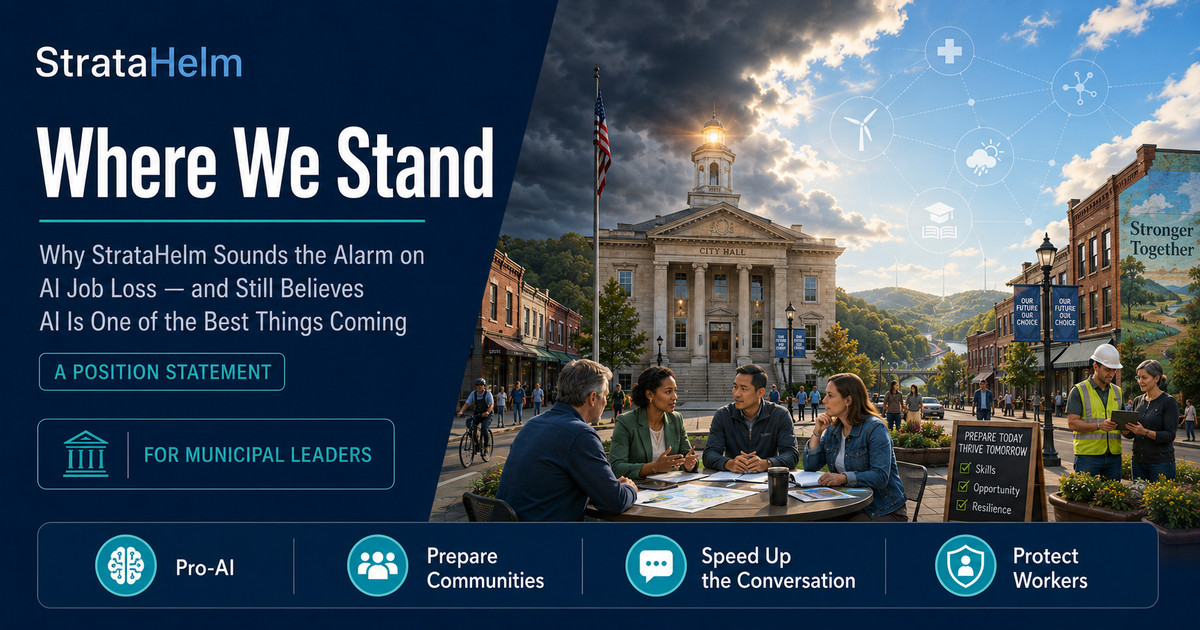
It would be easy to mistake an organization that spends its days measuring AI-driven job disruption for an organization that wants to slow AI down. We do not. This is our attempt to say clearly what we believe, so no one has to guess. We think AI will bring extraordinary benefits to humanity — curing diseases, cleaning up energy, expanding knowledge, feeding people — and we think the job-loss disruption we study is real, serious, and worth preparing for now. Those two beliefs are not in tension. Our position is not "slow the technology." It is "speed up the conversation." The disruption is coming either way; the only question is whether communities meet it prepared or surprised. We build tools and write research to make it the former.
StrataHelm exists to bring awareness and hard data to one specific consequence of AI: its impact on local jobs and the communities that depend on them. We measure exposure county by county. We document what has worked and failed in past disruptions. We help municipal leaders see what is coming before it arrives. That is our lane, and we take it seriously. But awareness of a problem is not the same as opposition to its cause. We are not an anti-AI organization. We are not calling for a pause, a ban, or a slowdown. We believe the right response to disruption is preparation and adaptation — faster discussion, better policy, real support for affected workers — not putting a brake on a technology whose benefits we actively want.
We raise the alarm on job loss the way a coastal town raises the alarm on a storm — not to stop the tide, but to get people ready.
The companion essay in this series asks an uncomfortable question: if slowing AI pushes a cancer cure from 2028 to 2033, are you willing to tell those patients the delay was worth it? We take that question seriously, and it shapes where we land. The benefits of AI arrive on a timeline, and delay has a cost measured in lives and livelihoods not improved. So we do not want to slow the technology. What we want is for the conversation about consequences to run ahead of the technology instead of years behind it. The historical pattern of disruption is that the harm arrives first and the response arrives late — the retraining program funded after the factory closes, the diversification strategy launched after the anchor leaves. That lag is where the human damage concentrates. Our entire theory of usefulness is to close that lag: to get communities discussing exposure, solutions, and support for displaced workers during the hard next few years, not after them.
Honesty requires acknowledging that the disruption we study is not the only serious concern about AI, and in some analyses not even the gravest. There are real, credentialed worries about AI alignment — whether increasingly powerful systems will reliably do what their designers and society intend. There are real concerns about misuse — what malicious actors could do with capable AI in cybersecurity, in biology, in the manufacture of disinformation. There are concerns about concentration of power, about surveillance, about errors deployed at scale. We do not dismiss any of these, and we do not pretend job displacement is the whole story. We focus on jobs because it is where we can be most useful and because it touches communities directly and immediately — not because we think it is the only thing that matters. A serious organization names the risks it is not focused on rather than pretending they do not exist.
Here is the belief that ultimately orients us: the good AI will do is at least as important as the harm, and much of it is already visible in the peer-reviewed record. This is not faith. It is a trend line. Consider what has already happened, not what is promised.
In 2020, Google DeepMind's AlphaFold solved the fifty-year-old protein-folding problem; it has since predicted the structures of more than 200 million proteins — essentially all known to science — used by over two million researchers in 190 countries, and won the 2024 Nobel Prize in Chemistry (Nobel Prize Committee, 2024). In 2025, the first drug with an AI-discovered target and AI-designed molecule, Insilico Medicine's rentosertib, posted positive Phase IIa results in the lung disease IPF, published in Nature Medicine — the first clinical proof-of-concept for an AI-discovered drug, developed on a timeline measured in months where the industry norm is years (Nature Medicine, 2025). The disease-cure scenario is not speculative. It has entered the clinic.
In 2022, DeepMind and EPFL's Swiss Plasma Center trained a reinforcement-learning system to control the superheated plasma inside a tokamak fusion reactor in real time — adjusting magnetic coils thousands of times per second to hold shapes physicists had only theorized — published in Nature (Degrave et al., 2022). Plasma control is one of the hardest sub-problems standing between humanity and limitless clean fusion energy, and AI has begun to crack it. The same family of methods is being applied to quantum chemistry, materials design for better batteries and solar cells, and fundamental physics — the tools that deepen our understanding of the universe and our ability to power civilization cleanly.
AI weather models like DeepMind's GraphCast now produce accurate medium-range global forecasts in under a minute on a single machine, a task that once required hours on the world's largest supercomputers (Lam et al., Science, 2023) — a direct aid to climate resilience, disaster preparedness, and agriculture. The same protein- and molecule-design capabilities transforming medicine apply to engineering hardier crops, breaking down pollutants and plastics, and improving the efficiency of getting food to regions facing shortage. The through-line is simple: AI is a general accelerant of scientific discovery, and scientific discovery is how humanity has solved its hardest problems.
Beyond any single breakthrough, AI is putting expert-level explanation, tutoring, and translation into the hands of billions of people who never had access to it — a democratization of knowledge whose long-run effect on human capability may dwarf any individual scientific result. A student anywhere with a phone now has a patient tutor. That is not a small thing.
None of this is a promise that everything will be fine, and we refuse to sell that. These are early results; many will not pan out; the benefits will not arrive all at once or evenly; and the same power that cures diseases carries the risks named above. "AI will eventually get us there" is a statement of directional confidence, not a guarantee of a smooth road — and the road is exactly where our work lives. The benefits accrue over years while the disruption hits specific people and places on a schedule of its own. Optimism about the destination is entirely compatible with urgency about the journey. In fact it demands it: if you believe the destination is worth reaching, you owe it to the people disrupted along the way to help them get there intact.
That is the whole of our position. We are not here to stand in front of the future. We are here to help our communities walk into it with their eyes open and their people cared for. If AI is going to be one of the best things that ever happened to humanity — and we believe it will be — then making sure it does not leave our towns behind on the way there is work worth doing.
Companion pieces in this series: "Would You Give Up Your Job to Save a Life?" and "Mind the Clock."