 HomeCountiesArticlesMethodologyContact
The Uncomfortable Moral Arithmetic of Slowing Down Artificial Intelligence
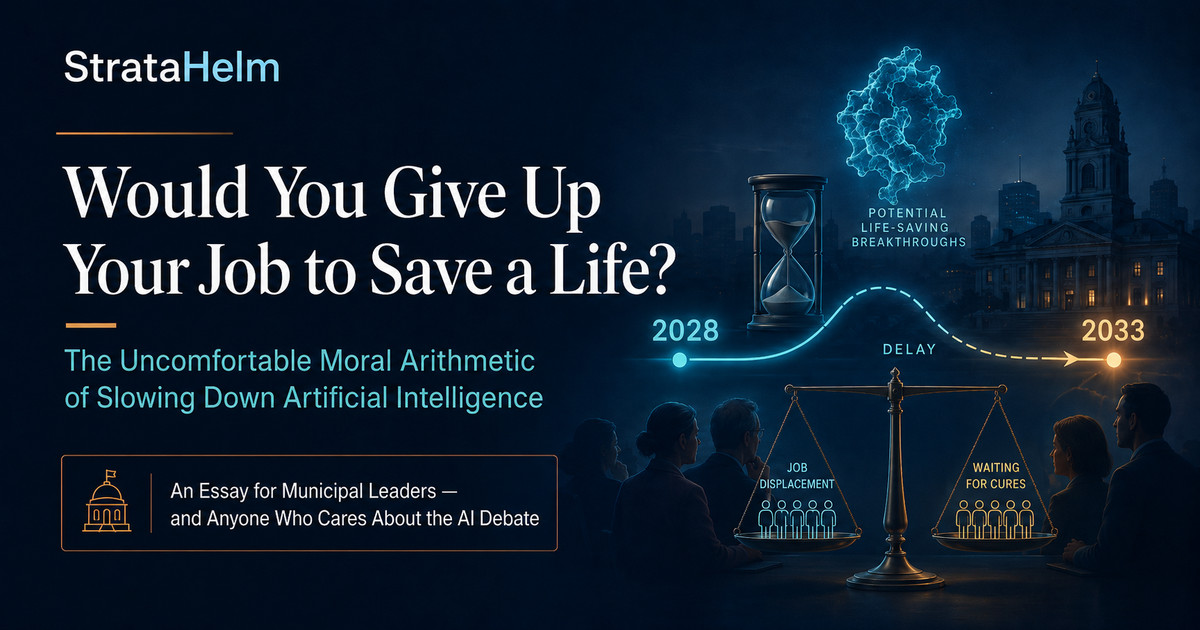
Here is a question worth sitting with before reading another word. Imagine artificial intelligence is on track to cure a particular cancer in March of 2028. Now imagine we collectively decide to slow AI down — for reasons that may be entirely legitimate — and in doing so we push that cure out to December of 2033. Between those two dates stand real people: patients who would have lived under the first timeline and will die under the second. The question is not rhetorical and it is not cheap. It is simply this: are you willing to look at those people and say the delay was worth it? This essay does not assume the answer is no. It assumes only that the question deserves to be asked honestly — because most conversations about slowing AI never ask it at all.
Much of the public AI debate is conducted as though caution is free. Slow down, add friction, pause, restrict — the language implies that the only thing at stake is corporate profit or technological vanity, and that the prudent, humane position is always to tap the brakes. This essay exists to insist on the other side of the ledger. Caution is not free. Every month that a genuinely life-saving capability is delayed has a body count, even when that count is invisible, diffuse, and statistical rather than named and photographed. A serious moral position on AI has to hold both costs at once: the concentrated, visible harms of moving too fast, and the diffuse, invisible harms of moving too slow. Ignoring either one is not caution. It is just looking away.
There is a well-documented feature of human moral psychology called the identifiable victim effect: we respond far more strongly to a single named person in peril than to large numbers of statistical lives. A child trapped in a well commands a nation’s attention; a policy that quietly raises mortality by a fraction of a percent across millions commands none. Both are real. Only one makes the news. The AI-slowdown debate runs headlong into this bias. The costs of moving too fast are often identifiable and vivid — a specific harm, a specific failure, a specific person wronged. The costs of moving too slow are almost always statistical — the diffuse population of people who would have been helped, on a timeline that never happened, by a cure that arrived late. Because our moral instincts systematically underweight the statistical victim, we are wired to overvalue the slowdown and undervalue its cost. Recognizing that bias does not resolve the debate. But refusing to recognize it corrupts the debate from the start.
The person saved by speed is just as real as the person harmed by it. They are simply harder to see.
It would be easy to dismiss the opening scenario as science fiction. It is not. AI has already begun changing outcomes across medicine — in screening, in emergency care, in drug discovery, and in who can get diagnosed at all — in ways that were, a decade ago, considered impossible. Four examples, each drawn from the peer-reviewed literature rather than a press release:
Honesty demands the caveats, and they are real. The sepsis result is a prospective association, not a randomized trial — and its benefit depended entirely on clinicians acting on the alert quickly. Halicin and abaucin remain preclinical: they have cured infections in mice, not yet in people. MASAI, the strongest of the four, measured detection and interval cancers rather than deaths directly. Autonomous diagnostics are authorized but still unevenly adopted. None of this is a finished revolution. But note what the four have in common: different diseases, different mechanisms, different institutions, different countries — screening, acute care, drug discovery, and access to diagnosis, all moving at once. That breadth is the point. AI is not promising to accelerate medicine someday. It is already doing it, across the peer-reviewed literature, right now. Which means the opening scenario is not a fable. It is a forecast with the decimal point still being placed.
If this essay only argued one side, it would commit exactly the sin it accuses others of. So let the case for slowing down be stated at full strength. The risks of advanced AI are not imaginary. There are serious, credentialed concerns about alignment — whether powerful systems will reliably do what we intend; about misuse — what bad actors could do with these tools in cybersecurity, biology, or disinformation; and about concentration of power, economic disruption, and errors deployed at scale. Some of these risks are potentially catastrophic and irreversible, and irreversibility changes the math: a delayed cure is a tragedy, but a catastrophic, permanent harm is a different category of loss. A rational person can look at that asymmetry and conclude that some caution, on some capabilities, is worth real costs — including the cost of delayed benefits. That is a coherent, defensible position. It is not the position this essay attacks.
What deserves attack is not caution but unpriced caution — the reflexive assumption that slowing down is costless, that the humane instinct is always to restrict, and that anyone pointing to the benefits of speed is a shill or a fool. That assumption is morally lazy. The honest position is not "go fast" or "go slow." It is "count both columns." A slowdown that prevents a genuine catastrophe may be worth an enormous cost in delayed benefits. A slowdown that merely soothes our discomfort with change, while quietly pushing a cancer cure from 2028 to 2033, is not caution — it is a decision to let identifiable fear outvote statistical lives. The difference between those two slowdowns is the entire ballgame, and you cannot tell them apart without doing the arithmetic the identifiable-victim bias tempts us to skip.
It may seem strange for an organization concerned with AI-driven job loss to write an essay defending the speed of AI. It is not. The whole premise of our work is that you can care deeply about the harms of AI — we spend most of our time documenting one of them — without pretending those harms are the only thing on the scale. We take job displacement seriously precisely because we take AI seriously, and taking AI seriously means acknowledging that the same technology reshaping local labor markets is also, in the same years, curing diseases and expanding what humanity can do. Holding both truths at once is not a contradiction. It is the only intellectually honest place to stand. Our opening position statement, "Where We Stand," set out where we land: we are pro-AI, we do not want to slow the technology down, and we believe the right response to disruption is to speed up the conversation about consequences rather than apply a brake. This essay is the harder companion to that one. It is easy enough to declare yourself against a slowdown; it is harder to spell out what a slowdown would actually cost, and to whom. That is the debt this essay is meant to pay.
So return to the person we started with — the patient who lives under the 2028 timeline and dies under the 2033 one. You are allowed to decide the delay is worth it. Perhaps the risk it averts is grave enough. But you are not allowed to pretend that person does not exist, or that choosing their delay was free. That is the discipline this essay asks for: not a particular answer, but an honest accounting. Would you give up your job to save someone’s life? Most people, asked directly, say yes without hesitation. The harder question — the one the AI debate actually poses — is whether you would let a stranger you will never meet die a few years sooner than necessary to slow a technology that frightens you. Answer it however your conscience demands. Just don’t answer it by looking away.
Abràmoff, M. D., Lavin, P. T., Birch, M., Shah, N., & Folk, J. C. (2018). "Pivotal Trial of an Autonomous AI-Based Diagnostic System for Detection of Diabetic Retinopathy in Primary Care Offices." npj Digital Medicine, 1, 39. See also FDA De Novo authorization announcement, April 2018.
Adams, R., Henry, K. E., Sridharan, A., et al. (2022). "Prospective, Multi-Site Study of Patient Outcomes after Implementation of the TREWS Machine Learning-Based Early Warning System for Sepsis." Nature Medicine, 28(7), 1455–1460.
Gommers, J., et al. (2026). "Interval Cancer, Sensitivity, and Specificity Comparing AI-Supported Mammography Screening with Standard Double Reading in the MASAI Study." The Lancet, 407(10527).
Hernström, V., Josefsson, V., et al. (2025). "Screening Performance and Characteristics of Breast Cancer Detected in the MASAI Trial." The Lancet Digital Health.
Lång, K., Josefsson, V., Larsson, A-M., et al. (2023). "Artificial Intelligence-Supported Screen Reading versus Standard Double Reading in the MASAI Trial: A Clinical Safety Analysis." The Lancet Oncology, 24, 936–944.
Liu, G., Catacutan, D. B., Rathod, K., et al. (2023). "Deep Learning-Guided Discovery of an Antibiotic Targeting Acinetobacter baumannii." Nature Chemical Biology, 19, 1342–1350.
Murray, C. J. L., et al. (2022). "Global Burden of Bacterial Antimicrobial Resistance in 2019: A Systematic Analysis." The Lancet, 399, 629–655.
Stokes, J. M., Yang, K., Swanson, K., et al. (2020). "A Deep Learning Approach to Antibiotic Discovery." Cell, 180(4), 688–702.
On the identifiable victim effect: Schelling, T. (1968) and subsequent behavioral-economics literature (e.g. Small, Loewenstein & Slovic, 2007) documenting stronger moral response to identified than statistical lives.
Note: The specific 2028/2033 dates are illustrative, not predictions. They are used to make the moral structure of the trade-off concrete, not to forecast any particular cure.
Companion piece: "Where We Stand" (StrataHelm position statement).