 HomeCountiesArticlesMethodologyContact
Claims Processing, Bookkeeping, and Administrative Support Are the Routine Work Most Exposed to AI Today — and Some Towns Depend on It More Than They Realize
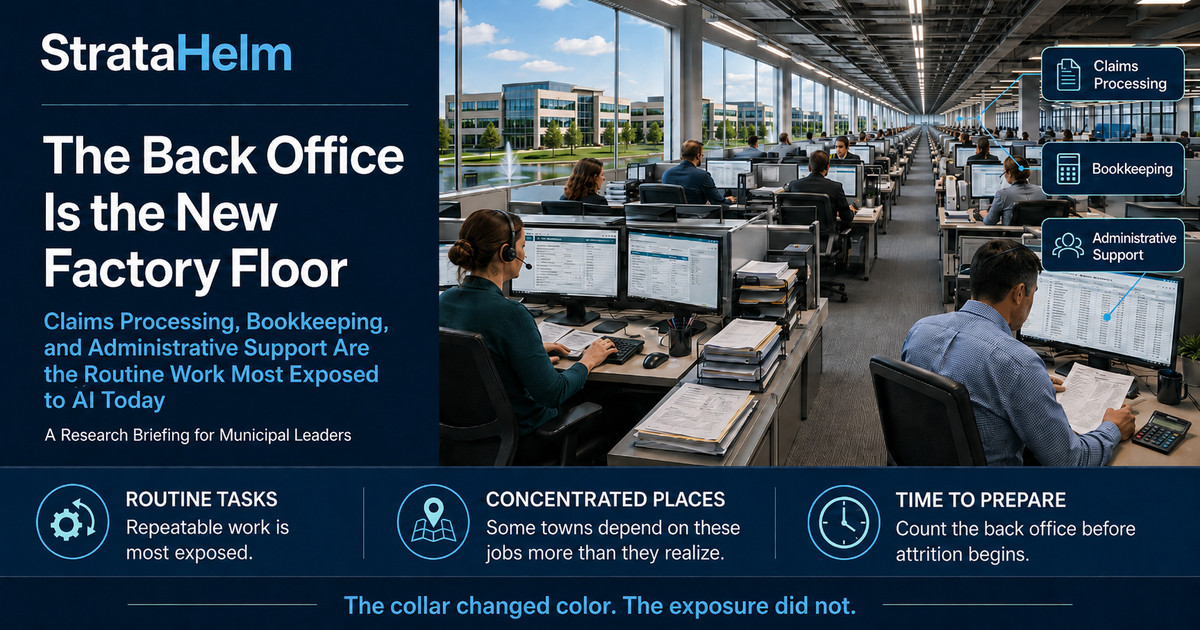
For most of the twentieth century, the archetypal vulnerable job was on a factory floor: routine, repetitive, concentrated in specific towns, and one automation wave away from disappearing. That job still exists, but it has a white-collar successor that is more exposed today and far less discussed — the back office. Claims processors, bookkeepers, general office clerks, and administrative support staff perform exactly the kind of routine cognitive work that current AI does most readily, and the federal government now projects these occupations to shed hundreds of thousands of jobs this decade, naming AI explicitly as a cause. The parallel to manufacturing is not loose analogy; it is close to mechanical. And like manufacturing, back-office employment is not spread evenly across the map. It clusters — in insurance capitals, financial-processing hubs, and the suburban office campuses that quietly anchor whole regional economies. This briefing identifies the exposed work, the towns that depend on it, and why communities that think of themselves as safely "post-industrial" may be carrying more concentration risk than any mill town ever did.
The factory floor was dangerous, for employment purposes, because the work was routine: broken into predictable, repeatable steps that a machine could eventually learn to do. That same property — routineness — is what makes work exposed to artificial intelligence, and it turns out that a great deal of office work qualifies. Processing an insurance claim, reconciling a ledger, sorting and routing correspondence, entering and checking data, answering a predictable customer question: these are the cognitive equivalents of the assembly line, and they are precisely what large language models and workflow-automation tools now perform with increasing competence. The occupational-exposure research bears this out; clerical and administrative roles sit consistently near the top of the exposure rankings, because their task profiles overlap so heavily with what the technology can do. The back office is where the routineness that once defined the factory floor has migrated.
What made a job vulnerable in 1975 and what makes a job vulnerable in 2026 are the same thing: routine, repeatable tasks. The collar changed color. The exposure did not.
This is not a forecast about some distant frontier; it is already in the federal projections, stated plainly. The Bureau of Labor Statistics projects overall employment in office and administrative support occupations to decline by 761,900 jobs — about 3.9 percent — over the 2024–34 decade, the largest projected decline of any major occupational group (BLS Employment Projections, 2025). And BLS is unusually direct about the cause: it states that "the use of automated systems, including AI, is expected to contribute to declining employment of office and administrative support workers" (BLS, 2024–34 Projections Summary). The detail beneath the headline is where the exposure lives:
These occupations pay a median wage in the mid-$40,000s — solid, family-supporting jobs that require some training but not a four-year degree (BLS, median $46,320 for the group). They are, in other words, exactly the kind of stable middle-skill employment that anchored the industrial middle class, now facing exactly the kind of technological pressure that hollowed it out. And unlike the manufacturing decline, which unfolded over decades, the AI pressure on these roles is arriving inside a single projection window.
Here is the part most communities miss. Because back-office work feels modern and clean — office parks, not smokestacks — it is rarely recognized as the concentrated economic dependency it often is. But like the mills before them, these jobs cluster in specific places, and some regional economies are staked on them to a degree that would alarm their leaders if it were framed the way plant dependency once was.
The clearest examples are the insurance hubs. Des Moines, Iowa — known in the industry as "the Hartford of the West" — is a global insurance center trailing only Hartford and New York, with the insurance industry accounting for roughly 16 percent of the region’s jobs across more than 80 insurance and financial firms (U.S. Chamber of Commerce, 2025). Crucially, as the regional economic authority itself notes, insurance and financial firms "require large back-office, technology, and compliance teams that are concentrated in suburban office campuses" across West Des Moines, Urbandale, and Ankeny (Des Moines Metro Authority, 2026). That back-office concentration is precisely the exposed layer. Hartford, Connecticut — the original "insurance capital" — carries the same profile, as do Columbus, Ohio, and Omaha, Nebraska, home to Mutual of Omaha and a dense cluster of financial-processing operations.
More striking still are the small metros built around one financial employer — the white-collar company towns. Bloomington, Illinois, a metro of under 200,000, is headquarters to State Farm, and roughly 22 percent of the area’s jobs are in financial activities — nearly four times the national rate of 5.6 percent (Wealth Management / BLS QCEW, 2019). A resident of Bloomington is almost four times as likely to work in finance as the average American. Strip away the office-park aesthetics and the structural picture is indistinguishable from a mid-century mill town: a single dominant industry, a single anchor employer, and a workforce concentrated in exactly the routine tasks a new technology is learning to do. These communities have company-town exposure without the company-town self-awareness, precisely because "back office" does not sound like "factory."
The dynamics of what happens when a concentrated anchor unwinds are the subject of When the Anchor Sinks — and the mechanics translate directly from the mill to the office park.
Several things conspire to hide this exposure from the communities carrying it. The work is invisible in a way factory work never was — there is no shift whistle, no smokestack, no physical output rolling off a line, just office buildings that look like any other. The jobs are considered "good" and "modern," which makes them psychologically harder to imagine as vulnerable. The decline, when it comes, tends to arrive quietly — through hiring freezes, unfilled vacancies, and attrition rather than dramatic mass layoffs, so the erosion does not announce itself. And because the employers are often prestigious national firms rather than a single local plant, the dependency feels diversified even when it is not. A region can tell itself it has a thriving financial-services sector right up until it realizes that "financial services," locally, means a few thousand people doing claims processing and account reconciliation in three suburban office parks.
The story of the American factory town is well known and, by now, well mourned: routine work, concentrated in specific places, undone by a technology that could do it more cheaply. The uncomfortable argument of this briefing is that the story is not over — it has simply changed clothes. The routine work that is most exposed today wears a collar, sits at a desk, and processes claims and ledgers in a suburban office park, and it is concentrated in identifiable communities that mostly do not think of themselves as being at risk at all. The back office is the new factory floor. The communities that recognize this early — that look past the clean office-park surfaces to the routine task content underneath, and that count their exposure before the attrition begins — will have the one thing the mill towns never got: time to prepare while the anchor is still standing.
To see how your county’s exposure breaks down by occupation — including the routine administrative and clerical roles described here — and how to read that measure as position rather than prophecy, see Position, Not Prophecy.
CAERI scores every U.S. county on exactly this kind of occupational exposure — including the routine back-office work most exposed today — free to look up. See where your community stands →
U.S. Bureau of Labor Statistics (2025). "Employment Projections — 2024–34" and "Employment Projections: 2024–34 Summary" (office and administrative support decline of 761,900 jobs / 3.9%; AI named as a contributing cause). bls.gov.
U.S. Bureau of Labor Statistics. Occupational Outlook Handbook: "Office and Administrative Support Occupations," "Bookkeeping, Accounting, and Auditing Clerks," "General Office Clerks," and "Financial Clerks." bls.gov/ooh.
U.S. Chamber of Commerce (2025). "The Insurance Capital of the U.S.? Look to Des Moines" (insurance ≈ 16% of regional jobs; 80+ firms). uschamber.com.
Des Moines Metro Authority (2026). "Major Employers in the Des Moines Metro Area" (back-office, technology, and compliance teams concentrated in suburban office campuses). desmoinesmetroauthority.com.
Wealth Management / BLS Quarterly Census of Employment and Wages (2019). "These 15 U.S. Cities Have the Most Financial Services Jobs" (Bloomington, IL: 22% of jobs in financial activities vs. 5.6% nationally; State Farm). wealthmanagement.com.
Occupational-exposure research: Felten, Raj & Seamans (2021); Eloundou et al. (2024). See "A Municipal Leader’s Glossary for the AI Economy" for definitions.
Companion StrataHelm briefings: "When the Anchor Sinks" and "Position, Not Prophecy." stratahelm.com/articles.