 HomeCountiesArticlesMethodologyContact
The Two Numbers Every County Needs — and Why a Bedroom Community and a Job Center Need Completely Different Plans
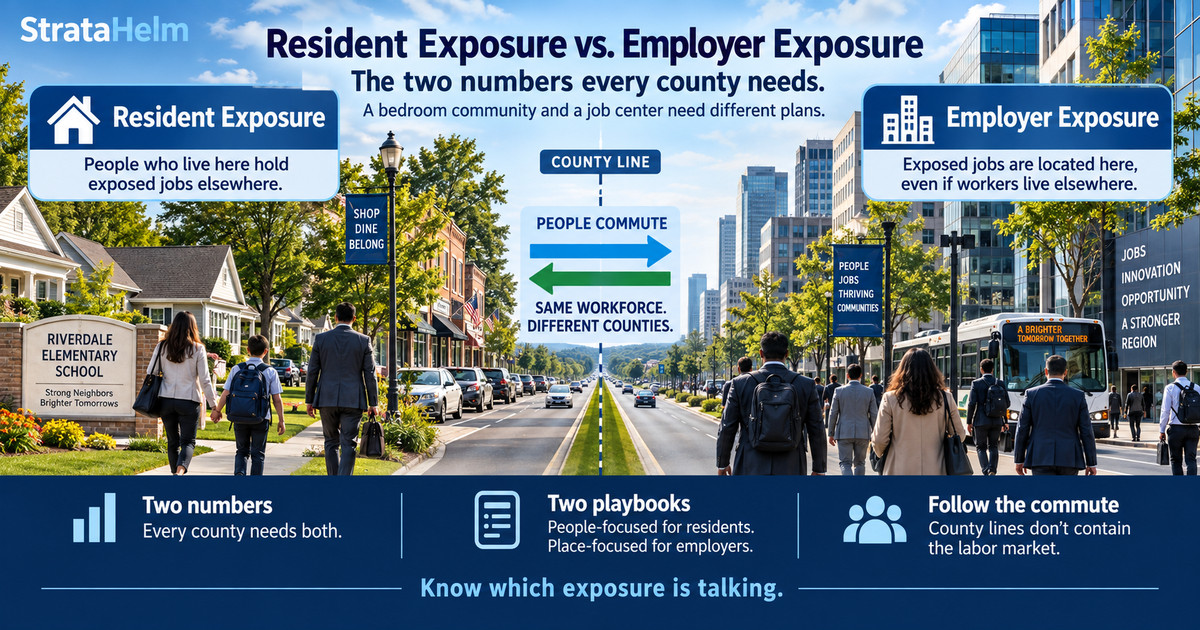
There is a distinction at the heart of AI-exposure analysis that most leaders miss, and missing it can send a community’s entire strategy in the wrong direction. A county has not one exposure number but two. The first is resident exposure: how exposed the people who live there are, measured by the jobs they hold — wherever those jobs happen to be located. The second is employer exposure: how exposed the jobs located within the county are, regardless of who commutes in to fill them. In a community where everyone lives and works in the same place, these two numbers are nearly identical and the distinction does not matter. But most American communities are not like that — workers cross county lines by the millions every day — and where they differ, the two numbers can tell opposite stories. A bedroom community can have low employer exposure and high resident exposure. A job center can have the reverse. Confuse the two, and you will build a workforce plan for a problem your community does not have while missing the one it does. This briefing explains the distinction, the federal data behind it, and why getting it right is the difference between a plan that fits and a plan that misfires.
Start with two imaginary counties to make the idea unmistakable. The first is a prosperous suburb full of professionals — accountants, analysts, administrators — who commute to office jobs in the city next door. Within its own borders there are mostly schools, shops, restaurants, and services. Its employer exposure — the exposure of the jobs physically located inside the county — looks low, because those local jobs are largely hands-on service work. But its resident exposure is high, because the people who live there hold exactly the exposed cognitive jobs that happen to sit one county over. A map of local employers would tell this community it is safe. It is not.
The second county is the reverse: a job center with a downtown full of back-office and administrative employment, staffed largely by workers who commute in from surrounding counties. Its employer exposure is high — the jobs inside its borders are the exposed ones. But its resident exposure may be moderate, because many of the people who actually live there work elsewhere or in less-exposed local roles. Here, a plan built only around resident exposure would badly understate the risk to the local tax base and the downtown economy.
The same county can be a safe place to live and a fragile place to work — or the opposite. Which one you are determines which plan you need.
The two numbers diverge because the geography of where people live and where they work came apart decades ago. Americans cross jurisdictional lines to work in enormous numbers: in the Austin metro, for example, Census data shows that roughly a quarter of the jobs located in the region are filled by commuters coming in from outside it, while hundreds of thousands of the region’s own residents travel out to work elsewhere (Austin Chamber, analyzing Census LODES, 2019). This is not unusual; it is the norm for most metropolitan areas. A county line is an administrative boundary, not a wall, and the labor market flows straight through it. Any analysis that assumes the people who live in a county are the same people who work in it — that residence and workplace are one population — is describing a country that stopped existing generations ago.
This is not a novel or exotic framing; the U.S. Census Bureau has measured both numbers for two decades, and any rigorous analysis draws on that infrastructure. The Longitudinal Employer-Household Dynamics program’s LODES dataset (LEHD Origin-Destination Employment Statistics) provides exactly the two perspectives this briefing describes, in its own terminology:
The Census even has vocabulary for the two archetypes. In its OnTheMap framework, areas that draw workers in are called "sinks," and areas whose residents leave to work elsewhere are called "sources" (Applied Geographic Solutions, on LODES). A job center is a sink; a bedroom community is a source. The distinction is not something an analyst invents — it is baked into the federal data infrastructure, waiting to be used. What matters is that an exposure analysis actually uses both margins rather than silently picking one and calling it "the" exposure.
This is also why the distinction is not optional in formal planning: many states’ WIOA local-plan instructions explicitly require an analysis of the commuting inflow-and-outflow patterns of the area’s workforce — a requirement discussed in Writing AI Resilience Into Your CEDS and Workforce Plan.
The distinction matters because the interventions that address resident exposure and employer exposure are almost entirely different. Getting the diagnosis wrong means aiming the right tool at the wrong target.
Your challenge is your people, not your places. The residents who live in your community hold exposed jobs — jobs that are, crucially, located somewhere else, outside your direct economic-development reach. You cannot protect those jobs by courting local employers, because the risk is in another jurisdiction’s office parks. Your levers are people-focused: workforce retraining and adaptability programs, support for affected residents, and attention to what happens to your housing values and local spending if a wave of your residents sees their incomes fall. Your fiscal risk runs through your residents’ wages and property values, not through your local business base.
Your challenge is your economic base and your budget. The exposed jobs sit inside your borders, which means their decline threatens your downtown, your commercial real estate, your local business ecosystem, and — depending on your revenue structure — your tax base directly. Your levers are place-focused: economic diversification, supporting the employers most exposed through their transition, and stress-testing the municipal budget against a contraction in local employment. And there is a wrinkle the resident-exposure community does not face: many of the workers at risk may not even be your residents or voters, which complicates the politics of acting on their behalf even as their jobs anchor your economy. Where that in-borders employment is concentrated in claims processing, bookkeeping, and administrative support, The Back Office Is the New Factory Floor profiles what that concentration looks like up close.
For the bedroom community, the fix is in the workforce. For the job center, the fix is in the economy. Same word — "exposure" — opposite playbooks.
Many counties, of course, are neither pure bedroom community nor pure job center, and carry meaningful exposure on both margins — significant exposed employment within their borders and significant exposure among their residents who commute out. These places need both plans at once, and they are also the places where reading only one number is most dangerous, because a single blended figure can mask a serious problem on one side. The discipline is the same regardless of type: look at both numbers, understand which describes your people and which describes your economy, and match the intervention to the target.
"Exposure" sounds like one thing, but for any community whose residents and workers are not the same people — which is to say, nearly all of them — it is two. The exposure of the people who live in a county and the exposure of the jobs located there are distinct measurements that can point in opposite directions, and the federal data has kept them separate for twenty years for exactly that reason. A leader who knows which number describes their community, and which describes the neighbor they trade workers with, can build a plan that fits. A leader who sees only a single blended figure is as likely to be reassured by it as warned — and may confidently prepare for the wrong future. Two numbers. Every county needs both. The plan depends entirely on knowing which one is talking.
For how to read either number as relative position rather than prediction, see Position, Not Prophecy; for the underlying vocabulary, see A Municipal Leader’s Glossary for the AI Economy.
CAERI measures both resident exposure and employer exposure for every U.S. county — and the commute flows that connect them — so you can see which kind of community you actually are. See where your community stands →
U.S. Census Bureau, Longitudinal Employer-Household Dynamics (LEHD) program. LODES (Origin-Destination Employment Statistics): Residence Area Characteristics (RAC), Workplace Area Characteristics (WAC), and Origin-Destination (OD) files; accessed via the OnTheMap application. lehd.ces.census.gov; onthemap.ces.census.gov.
Austin Chamber of Commerce (2019). "Commuting Patterns," analyzing Census LEHD/LODES data (share of regional jobs filled by in-commuters; residents commuting out). austinchamber.com.
Applied Geographic Solutions (2026). "Workplace Demographics and Commuting Flows" (LODES "sources" and "sinks" framing). appliedgeographic.com.
U.S. Census Bureau, Center for Economic Studies (2017). "Two Perspectives on Commuting: A Comparison of Home to Work Flows Across Job-Linked Survey and Administrative Files," Working Paper CES-17-34 (ACS vs. LEHD commuting measures). census.gov.
Companion StrataHelm briefings: "Writing AI Resilience Into Your CEDS and Workforce Plan," "Position, Not Prophecy," and "A Municipal Leader’s Glossary for the AI Economy." stratahelm.com/articles.